How to Make a Long Journey Comfortable for an Older Traveler
A long car ride, flight, or train trip asks an older body for something it isn’t built for.
That means staying in one position for hours at a stretch.
Joints stiffen.
The neck has nowhere comfortable to rest.
Sitting still that long carries a real circulation risk too.
None of that means travel is off the table.
It means the trip goes more smoothly with a plan for the journey itself, not only the destination.
Here’s how to handle the hours before you leave, the time in the seat, and the stops along the way.
Why hours in one seat are harder on an older body
A short car ride barely registers.
A five-hour drive, a cross-country flight, or a long train trip is a different matter.
Hips, knees, and the lower back all stiffen when they hold one angle for hours.
That stiffness doesn’t always ease the moment you finally stand up.
Sleep adds its own trouble.
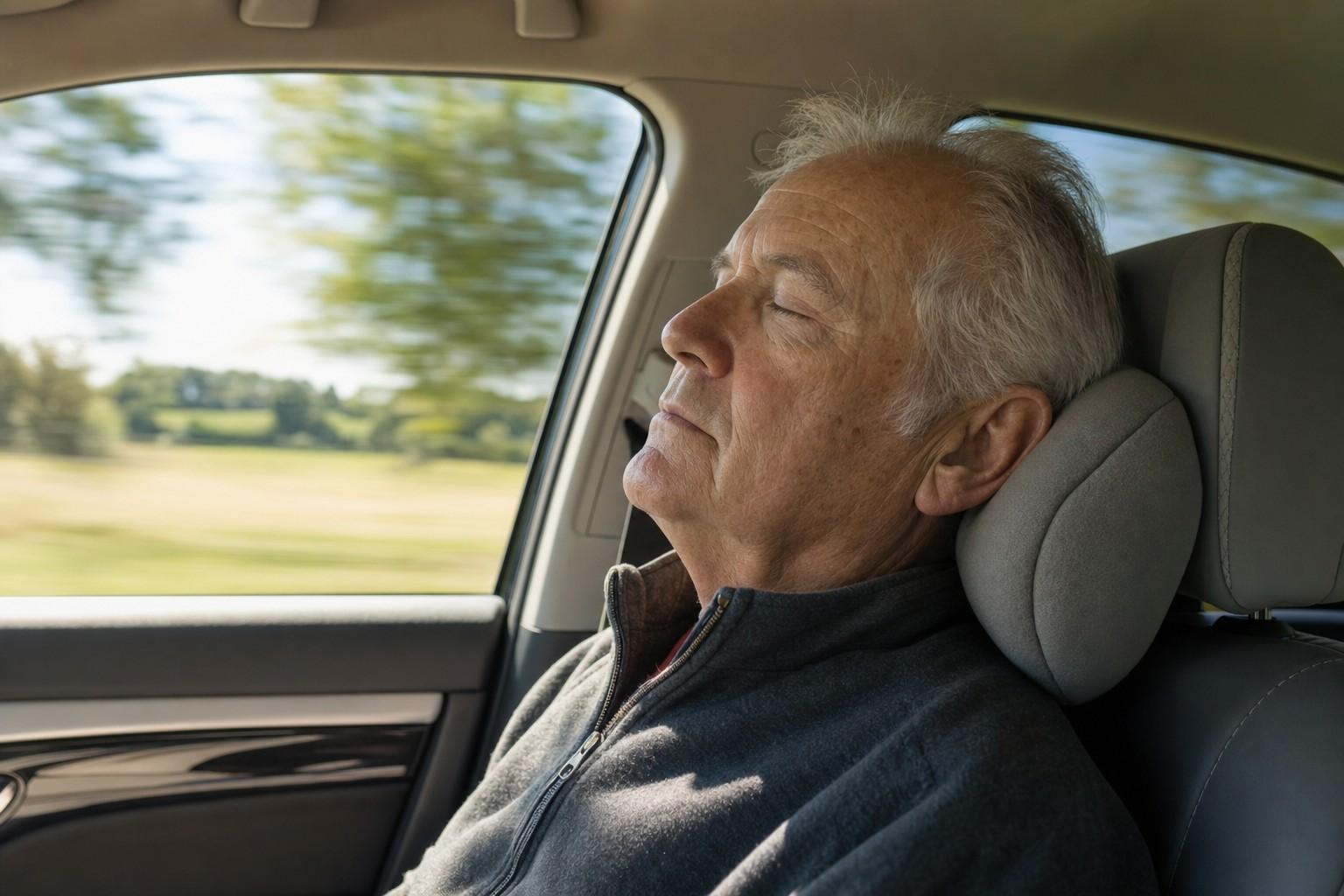
In a seat, the head has nowhere reliable to rest.
When sleep comes, it often arrives at an awkward angle, and a sore neck can color the entire first day of a trip.
Sitting still for a long stretch also brings a real circulation risk, not just an achy one.
That risk is exactly why a planned break matters more than pushing straight through, covered in full further down.
What to pack for the seat
Most of the planning work, choosing flights, booking hotels, working out logistics, happens before this stage.
If that part is still ahead of you, the guide to traveling with elderly parents covers it in detail.
This piece picks up once the tickets are booked.
It focuses on the hours actually spent getting there.
A few things packed the night before make those hours easier.
Bringing a neck support pillow solves the “nowhere to rest” problem directly.
Holding the head upright during a nap prevents the stiff neck that comes from dozing in an unsupported position.
Travel neck pillows pack flat, unlike the bulkier pillows made for a bed at home.
Loose, layered clothing beats anything tight or stiff.
Temperature swings between a car, an airport, and a cabin, and shedding a layer is easier than sitting cold for three hours.
Shoes that slip on and off matter more than they sound.
Ankles can swell over a long trip, so shoes that fit fine at departure may feel tighter by the final hour.
If seating is a choice, an aisle seat makes it far easier to get up without asking two strangers to move first.
During the hours in the seat
Once underway, small adjustments do more than most people expect.
Moving often, even in small ways, keeps blood flowing and joints from locking up.
- Shift position every twenty or thirty minutes, even without standing up.
- Roll the ankles and flex the feet.
- Change the angle of the knees.
- Stand and take a few steps whenever that is an option.
Sitting upright with the lower back supported cuts the strain that builds into a sore back by hour three.
A rolled sweater works as a support if a proper cushion isn’t handy.
Drink water at a steady pace rather than a lot at once.
Being underhydrated makes stiffness and fatigue worse, though there’s no need to overdo it either.
If a cane usually comes along, keep it within reach rather than stowed overhead.
Legs that have stiffened from sitting take a moment to feel steady again, so pause and find your balance before walking off.
Take a break every hour or two
Of everything in this guide, this matters most: don’t try to push straight through to the destination.
Build in stops instead.
On the road, that means an actual stop, not just slowing for a red light.
In the air or on a train, it means standing in the aisle or walking to the back when the seatbelt sign allows it.
This isn’t only about comfort.
Long stretches of sitting still are linked to a higher risk of blood clots forming in the leg veins.
That includes the kind of long stretch that comes with a car, train, or plane trip.
Doctors call it deep vein thrombosis, or DVT.
According to the Centers for Disease Control and Prevention, sitting for long periods, such as travel of more than four hours, raises the risk.
The fix is straightforward.
Moving the legs, whether that’s a lap around the cabin, standing at a rest stop, or flexing the ankles and feet while seated, helps.
That kind of movement is exactly what the CDC recommends for anyone sitting still on a long trip.
Risk isn’t the same for every traveler.
It rises for anyone with a history of blood clots, a circulation condition, or recent surgery.
If any of that applies, a quick check with a doctor before a long trip is worth it.
It’s a five minute conversation, not a reason to cancel a trip.
Make the stops count
A rest stop is not just for gas or a bathroom break.
Get out, walk the length of the parking lot, and stretch before getting back in.
On a flight with a layover, treat the terminal the same way.
Walking from one gate to another, rather than sitting the whole time, adds exactly the movement a long travel day is short on.
A short walk resets more than the legs. It eases stiffness in the hips and lower back too.
It also tends to make the next leg of the trip easier to sit through.
If getting through a terminal is the harder part of the stop, plan for that ahead of time rather than discovering it at the gate.
If a cane, walker, or wheelchair is part of the trip
Mobility equipment changes the boarding routine, not just the packing list.
Each kind has its own quirks worth knowing ahead of time.
- Cane users usually board easiest by boarding early. Ask the gate agent when traveling by plane with a cane, so there’s time to get down the aisle before the crowd builds up.
- Walkers typically check at the gate for free as mobility equipment, not as checked luggage. Confirm you can take a walker on a plane when booking, so it’s waiting at the jet bridge on arrival.
- A wheelchair escort turns a long terminal walk into a rest instead of more fatigue. It helps to know how much to tip an airport wheelchair attendant ahead of time.
- A recent injury changes the boarding routine too. Sort out stowage and seating questions for flying with crutches with the airline beforehand.
The bottom line
A long trip is genuinely harder on an older body, and for specific, fixable reasons.
Hours in one position, a neck with nowhere to rest, stiffening joints, and a real circulation risk all play a part.
A long trip doesn’t need an elaborate plan.
One habit matters most: a planned break every sixty to ninety minutes.
That can be a rest stop, a walk down the aisle, or a stretch at the gate.
Pack for the seat as much as for the suitcase, and the hours in transit stop being the hardest part of the trip.