CrossFit-Style Workouts for Seniors at Home (No Gym Required)
A sturdy chair, a clear stretch of hallway, and about 20 minutes.
That’s really all it takes for a functional workout built in the CrossFit style. It’s scaled down for a body that doesn’t need to prove anything to anyone.
This isn’t about pull-up bars or barbells.
It borrows the same idea CrossFit built its reputation on: short, varied movement that trains you for real life.
Squatting, pushing, carrying, and standing back up are the moves that keep someone independent at 75, not just fit at 25.
None of what follows is affiliated with CrossFit itself.
It’s the same training philosophy, scaled down and slowed way down for older joints.
These circuits build on the ideas covered in the broader guide to functional fitness for seniors.
Below, you’ll find a warm-up, three simple workout blocks, and a full week you can follow without setting foot in a gym.
Warm up before you start moving
Five minutes of easy movement wakes up the joints and lowers the risk of a strain.
Skipping it to save time is the most common way a good workout turns into a bad week.
- March in place, lifting the knees gently, for 1 minute.
- Roll the shoulders backward and forward, 10 times each direction.
- Do 5 slow, assisted squats, holding the back of a chair.
- Reach both arms overhead and out to each side, 5 times.
You won’t need anything beyond a chair, a kitchen counter, a staircase, and a couple of things already in the house.
Adding a few pieces of home functional fitness equipment later is optional, never required for these routines.
Five unhurried minutes is enough to loosen up before circuit one.
Circuit one, the 10-minute chair and counter round
This is the closest thing here to a classic CrossFit WOD, short for workout of the day.
It’s a small list of moves repeated for a set amount of time rather than a set number of reps.
Set a timer for 10 minutes.
Move through the three exercises in order, resting whenever needed, and repeat the sequence as many times as feels right.
- 8 chair squats: sit back toward a chair without fully sitting down, then stand.
- 8 counter push-ups: hands on the edge of a kitchen counter, lower and push back up.
- 8 step-ups: step up onto the bottom stair and back down, alternating legs.
Working the clock instead of a round count is what makes this circuit doable on a stiff day and challenging on a strong one.
Too hard? Cut the reps per round in half, or hold the counter during step-ups for extra balance support.
Circuit two, the sit-to-stand minute round
A CrossFit WOD for seniors often takes the shape of an EMOM, short for every minute on the minute.
At the top of each minute you do a small set of movement, then rest for whatever time is left before the next minute starts.
Set a timer for 8 minutes, one beep per minute.
At each beep, do 5 sit-to-stands: rise fully from a chair without pushing off with your hands, then sit back down with control.
Rest until the next beep.
The built-in rest is the whole point. It’s what makes an EMOM gentler on the joints than doing every rep back to back.
Too hard? Press off the chair with your hands, or stretch the interval to every 90 seconds instead of every minute.
Circuit three, the carry and walk loop
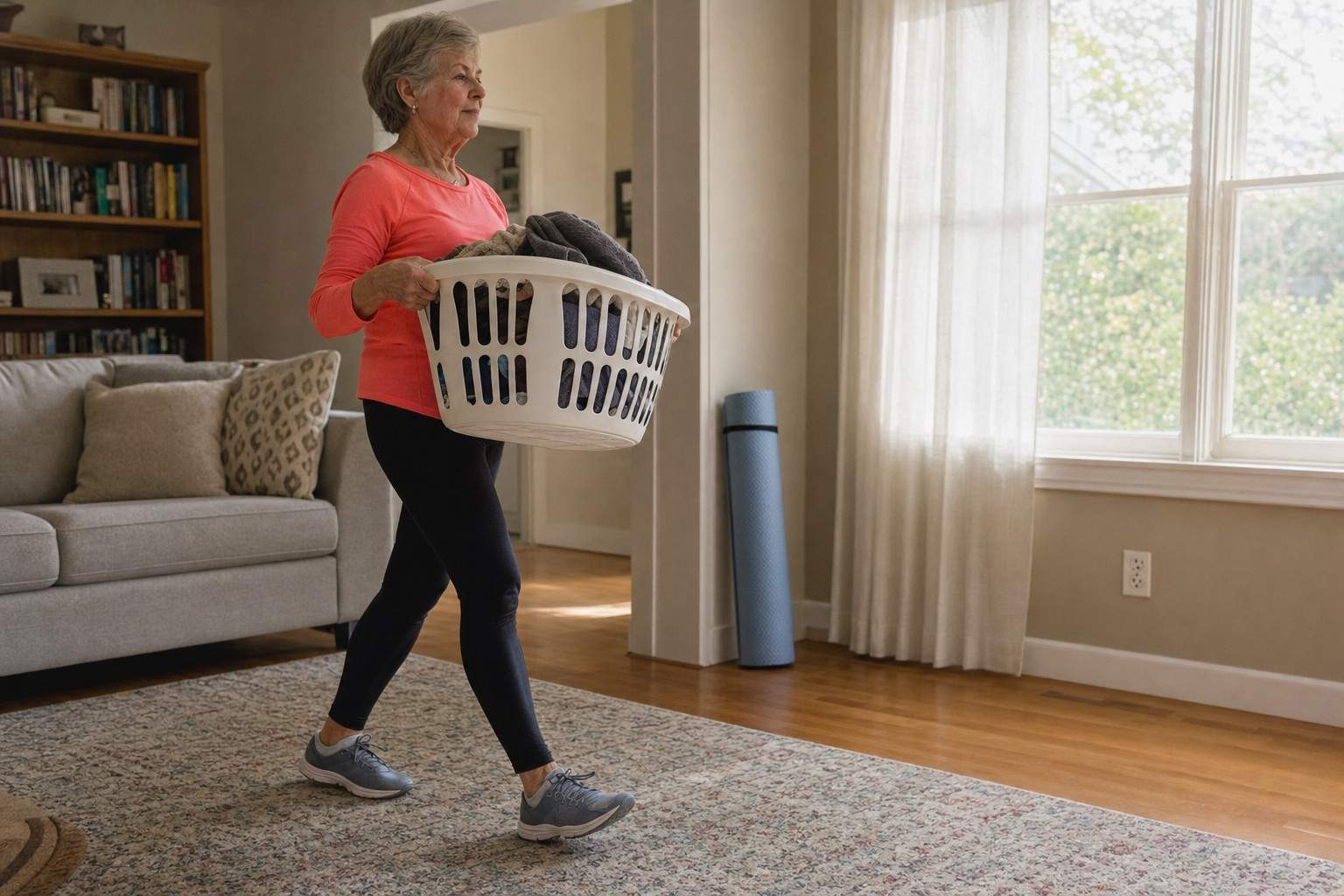
Carrying weight while walking, sometimes called a farmer’s carry in CrossFit gyms, builds grip strength and core stability.
That’s the same strength you use carrying groceries or a laundry basket.
Pick two items with a bit of heft.
Filled water jugs or grocery bags work well.
Walk a short hallway loop for 5 minutes, switching which hand carries the load every lap.
- Keep the shoulders level and the steps steady, not rushed.
- Set the items down and rest whenever your grip or arms feel tired.
- Repeat for a second 5-minute round if the first felt easy.
Too hard? Carry one item instead of two, or shorten the loop and add a short rest at each end.
Grip strength is one of the better predictors of overall strength in older adults, and this circuit trains it without a single dumbbell.
How many days a week, and how hard is too hard
The CDC recommends adults 65 and older get muscle-strengthening activity on at least two days a week, along with regular balance activities. These circuits cover both at once.
Two or three sessions a week, with a rest day between, is a reasonable starting cadence. More sessions aren’t automatically better if they come at the cost of skipping rest.
The simplest gauge of intensity is the talk test. During circuit one or three, you should be able to talk in short sentences but not comfortably sing. If a full conversation feels impossible, slow down or take a longer rest between rounds.
The talk test needs no watch or app, just attention to your own breathing while you move.
A safety note before you begin
This is general information, not medical advice, and it can’t account for your specific health history.
Check with a doctor or physical therapist first, especially after a recent surgery, with a heart condition, or with osteoporosis.
Stop right away if a workout brings on chest pain, dizziness, or shortness of breath that doesn’t ease with rest.
A physical therapist can also help scale any move that doesn’t sit right with an old injury or a sore joint.
Before starting week one, it’s worth taking the senior fitness test for a quick read on where you’re starting from.
Your one-week plan
Print this list or copy it into a notes app. Shift the days to fit your week; what matters is the rhythm, not the exact calendar.
- Monday: Warm-up, then circuit one (chair squats, counter push-ups, step-ups).
- Tuesday: Rest, or a short easy walk if you feel like moving.
- Wednesday: Warm-up, then circuit two (the sit-to-stand EMOM).
- Thursday: Rest, or gentle stretching.
- Friday: Warm-up, then circuit three (carry-and-walk).
- Saturday: Optional repeat of whichever circuit felt best this week.
- Sunday: Rest.
That’s the whole plan: three short circuits, two full rest days, and a warm-up ahead of each session.